Five Kitchen Experiments to Learn Everyday Pickling
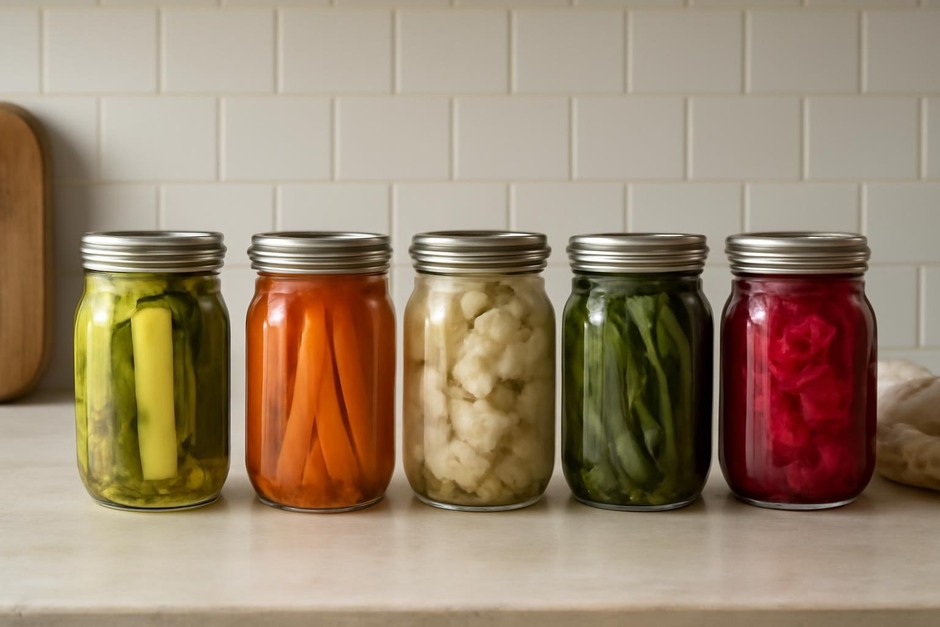
Pickling is a useful, low-cost skill for enjoying seasonal vegetables beyond their peak. These five short experiments are designed to be done in sequence over a few weeks: each is small, clear, and teaches an element you can repeat and adapt. You’ll need clean jars, basic measuring tools, a pot, and common pantry ingredients. Work on a sturdy surface, keep hands and utensils clean, and treat each experiment as a tasting and observation exercise.
Experiment 1 — Quick Refrigerator Pickles (30 minutes prep, 24+ hours rest)
Goal: Make a simple vinegar pickle so you understand balance of acid, salt, and sugar.
- Choose a crisp vegetable: cucumber, carrot batons, or radishes.
- Prepare a basic brine: 1 cup white vinegar, 1 cup water, 1 tablespoon sugar, 1 teaspoon salt. Warm until the sugar and salt dissolve.
- Place vegetables in a clean jar with a smashed garlic clove and a teaspoon of mustard seeds or peppercorns.
- Pour hot brine over vegetables, seal, cool, then refrigerate. Taste after 24 hours and note texture and flavor.
What to observe: how crispness changes, how strongly acidic the pickle tastes, and whether the sugar balances the vinegar. Try the same recipe with different vegetables to compare.
Experiment 2 — Adjusting Brine Ratios (30–45 minutes prep, 24+ hours rest)
Goal: Learn how changing vinegar, water, salt, or sugar alters flavor and preservation.
- Repeat Experiment 1 but make three small jars with different ratios: more vinegar (3:1 vinegar:water), more water (1:3 vinegar:water), and the original ratio with extra salt.
- Keep other elements constant: same vegetable cut and same aromatics.
- Label jars and taste them after 24–48 hours, noting the balance, intensity, and mouthfeel.
What to observe: which ratio you prefer for everyday use, and which impacts crispness. This builds your intuition for recipes and adapting to what you have on hand.
Experiment 3 — Spice and Herb Variations (20–60 minutes prep, 24+ hours rest)
Goal: Explore how a few simple spices change the character of a pickle.
- Use the brine ratio that suited you from Experiment 2.
- Make three small jars and flavor each with one dominant note: (A) dill and garlic, (B) coriander and bay leaf, (C) chili flakes and ginger.
- Taste after 24–48 hours and note aroma, heat, and how spice interacts with the vegetable.
What to observe: which spice families you prefer with different vegetables. This experiment builds confidence in matching flavors and creating signatures for salads or sandwiches.
Experiment 4 — Simple Lacto-Ferment (3–10 days)
Goal: Try a basic fermentation to learn about salt-only preservation and how time and temperature influence flavor.
- Shred cabbage or slice cucumbers thinly. Toss with non-iodized salt at roughly 2% by weight (about 1 teaspoon salt per 100 g/3.5 oz of vegetables) and massage until the vegetables release liquid.
- Pack into a clean jar, pressing down so the vegetables sit below their own brine. Weigh them down with a smaller jar or a clean stone if needed.
- Leave the jar at room temperature (ideally 16–22°C/60–72°F) and taste a small amount after 3 days, then again at 7 days. Refrigerate when you like the flavor to slow fermentation.
What to observe: the development of tang, texture changes, and any surface yeasts or scum (skim and discard any dry mold; if you see fuzzy, colorful mold remove and don’t taste). This introduces you to time as an ingredient and the different safety considerations of fermenting versus vinegar pickles.
Experiment 5 — Using Your Pickles in Everyday Meals (10–60 minutes)
Goal: Turn small batches into additions that transform everyday dishes and reinforce tasting skills.
- Take a quick pickle and add a spoonful to a grain bowl or sandwich to taste how acidity brightens the dish.
- Use a fermented cabbage as a crunchy side for roasted vegetables or mixed into a slaw with yogurt or oil.
- Keep a small jar of a favorite spice variation in the fridge as a finishing condiment; note how long it keeps and how flavor evolves.
What to observe: which pickles you reach for most, how long flavors remain pleasing, and what textures you want to preserve for future batches.
Final notes and gentle rules of thumb
- Use clean jars and utensils. Sterilize jars if you plan longer storage beyond refrigeration.
- Label jars with date and recipe notes so you can repeat successes and adjust what you dislike.
- For refrigerator pickles, store in the fridge and consume within a few months. For ferments, keep an eye on appearance and taste; when in doubt, discard.
These five experiments give you hands-on learning: brine balance, spice pairing, and the role of time and salt in preserving vegetables. Repeat any step with new vegetables or flavors and keep brief tasting notes—the simplest habit for becoming a confident home preserver.